'Production for Together Again'
Draft Script
Scripts
Final Script
Writing the Script
When it came to writing the script for the Music Video, I tried to include as much detail as I could. Within my film, I was planning on including many different scenes which takes place between intervals of 10 seconds or less. This meant that I had to have as much detail in the script that I could, to ensure I filmed everything for the right amount of time and that I had enough footage. Because I wrote the script a lot earlier than when I start filming, I included the shot types and transitions that I wanted with each scene. So when it came to filming, reading the script refreshed my mind and helped me remember what I was aiming for.
Risk Assessments
For Contingency reasons I have decided to film in only two places. The main filming location is my family's home, this is so if we go into lockdown the project wont need to be withheld or delayed. The risk assessment proves that this location is safe for both the cast and crew and the filming equipment. If on the day, the area seems to be to dangerous for the equipment or cast, then I will adjust the Train Station scene in the script and film elsewhere.
Pre-Visualization

Location Layout

'WandaVision'
I decided to do a location layout for the final scene with the husband and wife as it is the most impactful scene in my music video. I wanted to be prepared for it. Having a location layout helps me to understand the lighting and set out I need for the shot. In the final scene, the husband and wife are sitting on a sofa directly in the centre of the camera. I chose this shot from the influence of a scene of a 50's inspired television show, 'WandaVision'. This is because it shows the couple in love being the centre of attention of the scene.
Location Agreements
Contributer Release Forms
How I went about gathering the Forms
Production Forms
Props List
Equipment List
'Previsualization is the visualizing of complex scenes in a movie before filming. It is also a concept in still photography. Previsualization is used to describe techniques such as storyboarding, either in the form of charcoal sketches or in digital technology, in the planning and conceptualization of movie scenes.' I chose to create a pre-vis in substitute to a storyboard, so I could have an idea of the order of footage that I want. The drawing is not perfect as we only had 10 minutes. These are the scenes from the start to when they leave to reunite at the Train Station
Unfortunately, with Covid-19 restrictions, I was unable to visit the Wiltshire Council or the BOA Train Station to get a written copy for a Location Agreement. This meant that I had to send a blank digital copy over email and get it resent back to me complete. After discussing and emailing both the Train Station and the Council, I was able to get permission to film at the Train Station.
For the home scenes, gathering Location Agreements for that was simple enough as it was my own family's home. My parents were available to fill out the forms on a week night and at the same time filled out the Contribution Release forms as they are acting within the Music Video as well.

Learning from my last project with the camera continuation issues, I decided for this project I will keep to the same camera. The camera I used was my father's iPhone 11. The quality of that camera compared to my iPhone 8S is exceptionally better. The camera settings for the iPhone 11 include a wide angle lens and extreme close up HD qualities which is perfect for the new angles I wanted to experiment with in this Music Video. When exporting the taken footage to my iPhone 8 I used Bluetooth Airdrop to keep the quality of the videos. I had previously tried sending them over through Facebook Messenger but I found the quality decreased when saving it.


'Post Production for Together Again'
Finding the Software to Use:

Finding the Music:
Adding the 50's Effect:

Final Editing Screenshots
Technical Skills Evaluation
iPhone 11


Moodboard
Using Adobe After Effects:

Practice Makes Perfect
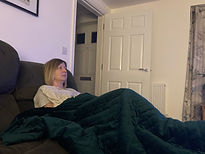
For this project I wanted to carefully choose my angles, pans and transitions. In order to be prepared for the production of my Music Video, I used whatever available time I had with my actors and locations to test out different camera techniques. These photos and videos are examples of me testing angles within the hallway, kitchen and living room. For the main scene, outside the Train Station, I practised the camera movement until I was confident that I could get it right within the first couple of attempts as I did not have much time leeway for filming this scene.



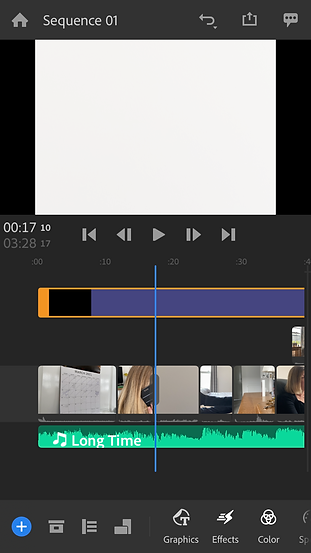
For my last project, I used Premiere Rush due to the lack of recourses available to me. For this music video I waited until I was in College to have the opportunity to use Premiere Pro, which is a step up software. When it came to using the software, I couldn't transfer the footage from my phone to the computer without losing some of the HD Pixel Quality. Not wanting the edit to be fuzzy, I decided to use my backup option, Premiere Rush. Unfortunately, I have had difficulty previously rendering and exporting my projects, as the coding causes my edits to glitch randomly. This has happened in two accounts within my music video, which prevents it looking professional. Sadly, I cannot fix it as it is the software's fault. Next time, I will film with a camera instead of a phone so I can export to Premiere Pro at College instead.
My whole Music Video is based around the style and time that the song 'It's Been A Long, Long Time' was created. The 1950's video productions was far from the style we create our projects nowadays. Colour photography was not as accessible or completely invented yet and TV's were boxed and square meaning the aspect ratio was 4 3. Because I wanted my project to be as accurately close to the 50's television era, I decided to add a square image aspect ratio and edit the colour into black and white. On top of that I downloaded the quality in 720p so the video was not as defined, much alike the 50's cameras. At the end of the Music Video, I also added 50's font style credits. The inspirations taken from the film 'The Westerner.' All of these were edited onto my project using Adobe After Effects and Premiere Pro.
Before having a song for my music video, I had no ideas of what I wanted to film for the storyline. This gave me plenty of leeway to what song I could have. I didn't need a song to fit a video as my video will be based off the song instead. A couple weeks prior to this brief being given to us, I watched the film 'Avengers Endgame'. Within the film, this song played and I fell in love with it. At the time it became my favourite song as it made me happy and warm. So when it came to deciding on a song that made me happy, I picked this one. This song was used in context in the film to a husband and wife reuniting again. using this as inspiration, my idea was created with 'It's Been A Long, Long Time' being the centre of the project. To get the song onto my software to edit, I used the website www.youtubemp3.us .It allowed me to download the mp3 from YouTube and add it to my video.
A couple scenes within my project included a car's number plate, which in order to be able to upload this publicly, needed to be blurred out. In order to make the plates unrecognisable, I went onto the Adobe software, After Effects, and used a masking tool to cover them. I started with using the pen tool and drew around the plate, making a box, then added the masking effect. The masking effect follows the picture with coding, accurately following the moving plate on the car throughout the shot. This keeps it completely covered without it jumping or me having to edit it animatingly. After the masking was on, I changed the settings to blur at 12 points, just enough so no one can read the numbers and letters. I repeated this process for both of my car scenes. I also used the software to add in rolling Credits to the end of my Music Video. To do that, I simply wrote out the names and positions, using the text tool, and then clicked the roll mode shown on the text's editing options.