'Pre-Production for Judgement Documentary'
Scripts
Questions for Interviewees
Because we are creating a Documentary, the script has been replaced with a program running order and interview questions. Connors questions are based around the Mental Health and LGBTQ+ Cultures as that is what he connects with most. The questions were created to ensure we get an answer we are looking for to put within our Documentary. For the filming of the interviews, Connor has agreed to answer all the questions truthfully. After filming, if there are certain sections he does not want included in the Documentary, for privacy reasons we will respect that and only use what he is comfortable with.
All of the questions are similar so when it comes to editing we will hopefully have answers we can join together. Asking each of them the same final two questions will ensure we get an answer we are looking for.
Storyboard
To accompany the Interviewer questions, I made a storyboard to help organise the shot order and type. This storyboard is not detailed nor drawn to accuracy, this is because depending on our final product, we may adapt it. If an interviewer answers a question in an impactful way, their scene may be included at the beginning of the documentary to create effect. Although this is not guaranteed so it has not been included in the script or storyboard.
Risk Assessments
For contingency reasons we have decided to only film in one location. The Yeovil College photography room is a perfect interviewee location to present the documentary in a professional, serious mood, as this topic is not a positive one. The risk assessment proves that this location is safe for both the cast and crew and the filming equipment.
Location Recce
Location Layout
This Location Layout is for the Photography Studio Interviews. All of the Interviews will be set out exactly the same each time in an attempt to keep the continuinity. To keep the focus mainly on the interviewee we have chosen a plain black background. We chose black over white as white enhances marks and creases on Camera whereas black does not. Black also suits the serious mood and the professionalism of the Documentary's genre. 2 LED Lights will be positioned on each side of the cast. A diffuser will be placed over the lights to not blind the interviewee and not over expose them on camera. The camera is placed directly in front other the cast with the interviewee looking directly into the camera at all times. This will give a connection to the audience as they talk about sensitive judgement.
'Pre-Production for The Lloyd's Family Documentary'
Narration Scripts
When planning the narration script I wrote down attributes that I want the narration to have. Instead of my voice being soothing and strict I wanted it to have character, with me pretending like I’m explaining the scene in that moment of time. I feel this will help the audience engage and feel entertained to the standards I am looking for.
I then started the script by first writing topics that I want to include in the Documentary. This also helped me decide on what footage I had to accompany it and what footage I needed to film for each topic. Because my family’s culture isn’t defined or categorised into a group, I decided to make our own attributes as topics. For example, I chose quiz nights, secret callings, pets, uno etc.
After having a rough script, I then printed out and edited the sheets of paper by adding comedy to each paragraph. The script has a draft and finalised version as I spoke with my instincts and gut when recording the narration so most of the narration is different to what was planned.
Forms
For legal reasons its important to have Location Agreements and Contributor Release Forms. This provides us with written permission from the cast and location managers that we can use them or their property within my Documentary. My Risk Assessments for this Documentary only have one location which is my family's home. Most of my footage is taken from B-roll before Production on this project began, so risk assessments and recce forms are unneeded for some locations. For example, outside by the lake and Harrod's. Because we are in lockdown, the documents have been filled and signed digitally for everyone's safety and quick access.
'Production for The Lloyd's Family Documentary'
Gathering Images From 'Pixabay'
Within the first 1 minute of my Documentary I plan to narrate an explanation of the definition of Cultures. With my sources limited I decided I would find images and videos online to use in a sequence for a montage. Finding images for B-Roll helped me, to widen my perspective on peoples idea of what Culture is. After searching up Culture on 'Pixabay' these 4 images appeared. Every one is diverse but fit well together as it represents the defined groups. These 4 images I will use as a scene so the audience is not just staring at a blank or still photo during my explanation.
Equipment List
With Covid-19 restricting my access to equipment from College, I had to work with the video equipment I had at home. Most of my B-Roll was filmed before this project was announced. Because I had recently bought a new phone, most of the footage was filmed on my old iPhone 6S. Any footage that I had to film in production of this project was filmed on my new iPhone 8 season 2020. The camera difference is significant which cause a continuinity problems when sequencing the footage together. I feel if I had the time and option to refilm things, I would keep to one phone. In terms of lighting I used: daylight, ceiling lights and my Father's iPhone X flashlight. As I was the only one part of the crew on this Documentary I filmed whilst holding the lighting. The flashlight in all indoor scenes is placed directly above the phone camera. This made my footage less fuzzy and more exposed.


iPhone 11
(Lighting)

iPhone 8 2020
(Production
Footage)
iPhone 6S
(B-Roll Footage)


iPhone 6S
iPhone 8 2020
'Post Production for The Lloyd's Family Documentary'
Finding the software to use
When it came to editing, I started off by searching up and researching different Software's on both my laptop and my iPhone. I have previously had experience with using 'Premiere Pro' on the Mac's at College. When Ray recommended different apps to me, I instantly noticed the app Premiere Rush. The app is very similar in its workings to the pro version. However, this version is free and can be used on either my laptop or phone. With having lots of experience with the Software, I chose it but decided to edit my Documentary on the phone version. I did this because, my footage is all portrait which is the shape of my phone, this makes it easier to edit.

Gathering Footage
Within my Documentary, I wanted to include footage from events or days from around the year. This will make it more authentic and not staged by filming it in one go. I didn't want it all to be scripted or forced upon my family as it wouldn't seem realistic. When writing the script, I looked back on videos from different moments of time to help me phrase and collaborate a script to accompany the footage. Videos that stuck out to me were put into a folder ready to sequence into my Documentary. When I didn't have enough footage causing gaps in my edit, I wrote down on the script alternatives that I could film during production to fill the spaces.
Finding the Music

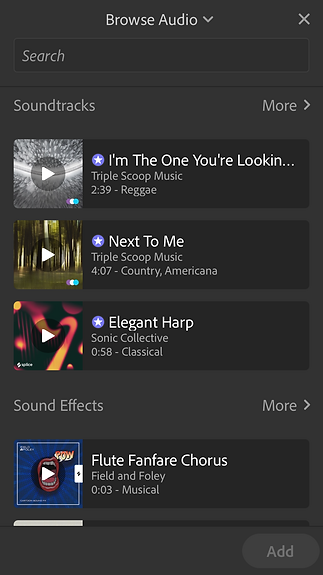
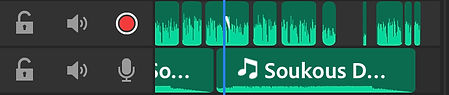
The music behind my Documentary was found via the premiere rush app. I started searching for the perfect song by filtering the free music by genre. I chose cultural and upbeat which suits the brief and my films mood. The song is called 'Soukous Dakar'.


Recording the Narration
For the Narration, I gave myself two options on how to record it. Firstly, I began with my iPhone audio notes, but that appeared troublesome when coming to add it onto my edit on Premiere Rush. The files were too large and fuzzy when exported. This was not ideal considering the Narration is one of the main focuses of the Documentary. After that plan was not a success, I resolved to recording the audio using the app. This was far simpler as my voice automatically generated into an audio clip over my Film.
(Narration)
(Music)
Final Editing Screenshots


